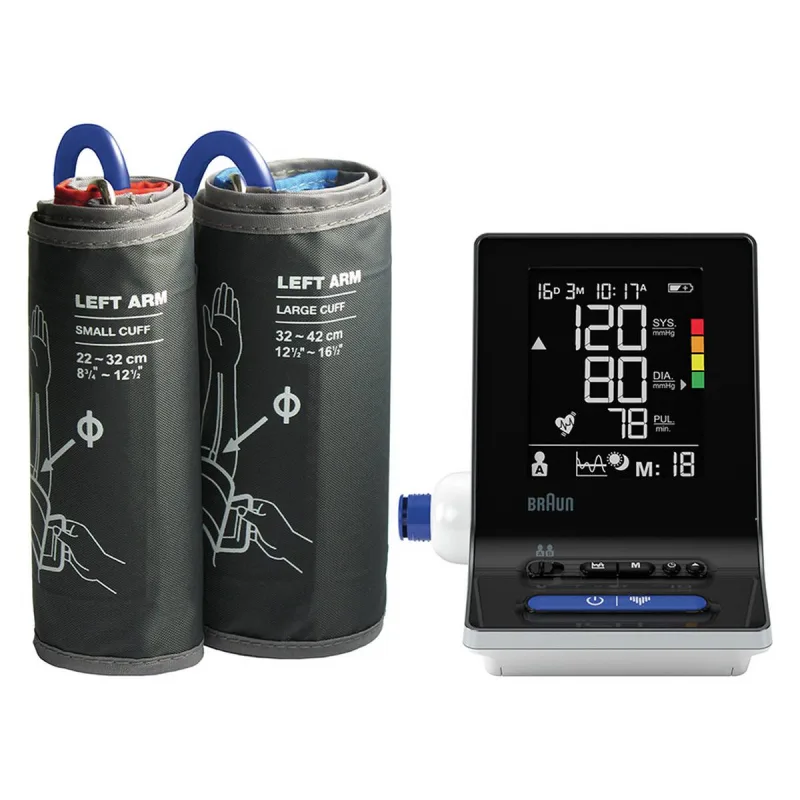
Braun ExactFit 3 BUA6150
A mid-priced monitor that ships with two cuff sizes, so a wide range of arms is covered without buying extras.
Check Price on Amazon Read the full reviewOur verdict: The best blood pressure monitor in 2026 is the Braun ExactFit 3 BUA6150. It tops our ranking with 9.0 out of 10.
Fewer picks than usual: no other model in the top half is better value.
A mid-priced monitor that ships with two cuff sizes, so a wide range of arms is covered without buying extras.
Check Price on Amazon Read the full review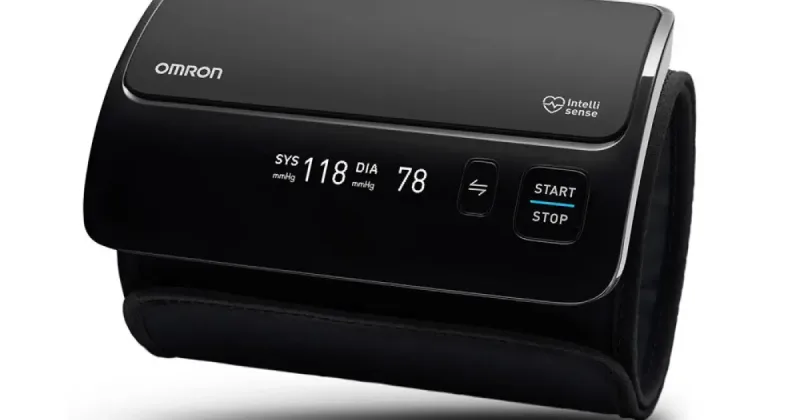
A one-piece upper-arm monitor with no tube or separate unit, so the whole thing wraps round the arm.
Check Price on Amazon Read the full review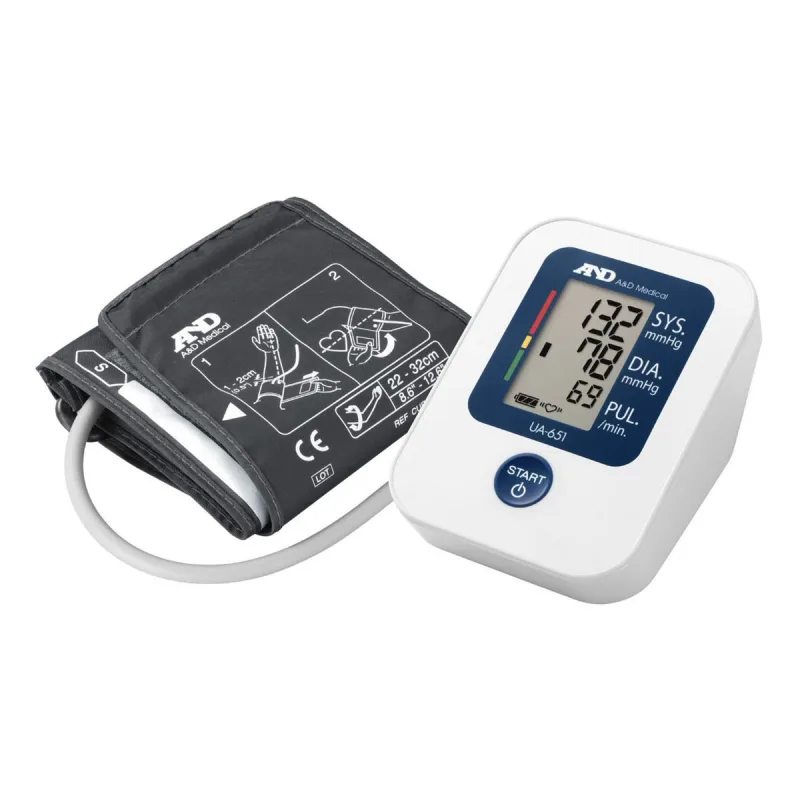
A long-running budget monitor that keeps things simple: a 30-reading memory, an average and a slim cuff.
Check Price on Amazon Read the full reviewWe compared 19 home blood pressure monitors sold in the UK, then ranked ten of them by how happy owners are. These ten are all upper-arm models, from basic one-button units to Bluetooth monitors with AFib screening, across a wide price range. Every product links to its full review below.
Braun ExactFit 3 BUA6150Best Choice
9.0 out of 10
Check Price
A&D Blood Pressure Monitor UA-651Best Budget
8.7 out of 10
Check Price
 Beurer BM 27
8.7 out of 10
Check Price
Omron EVOLV Smart Home Blood Pressure MonitorBest Premium
8.6 out of 10
Check Price
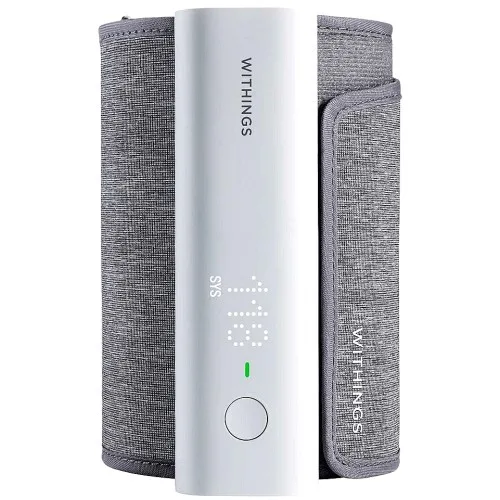 Withings BPM Connect
8.1 out of 10
Check Price
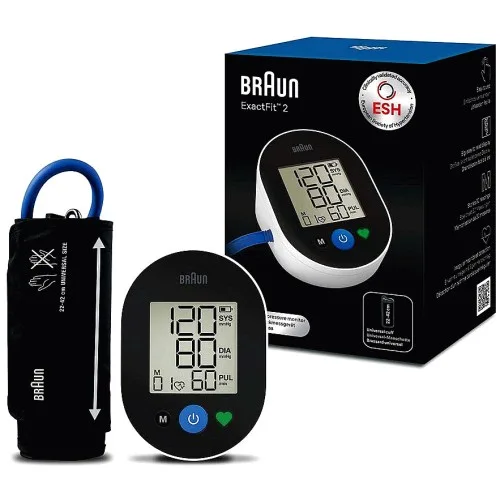 Braun ExactFit 2 BUA4050
8.1 out of 10
Check Price
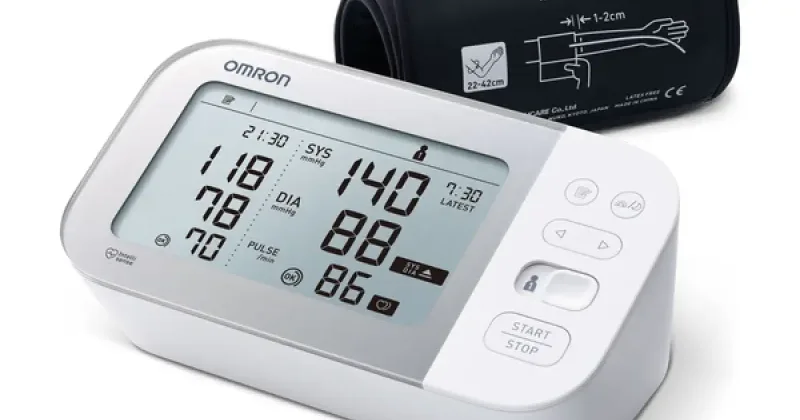 Omron X7 Smart AFib HEM-7380T1-EOSL
8.0 out of 10
Check Price
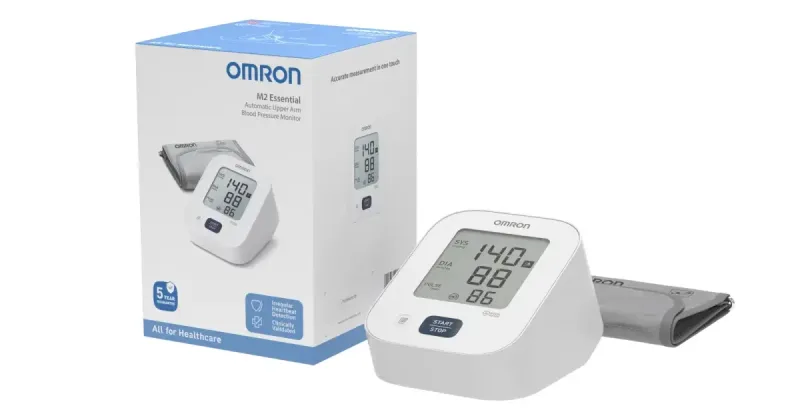 Omron M2 Essential HEM-7188-E
7.9 out of 10
Check Price
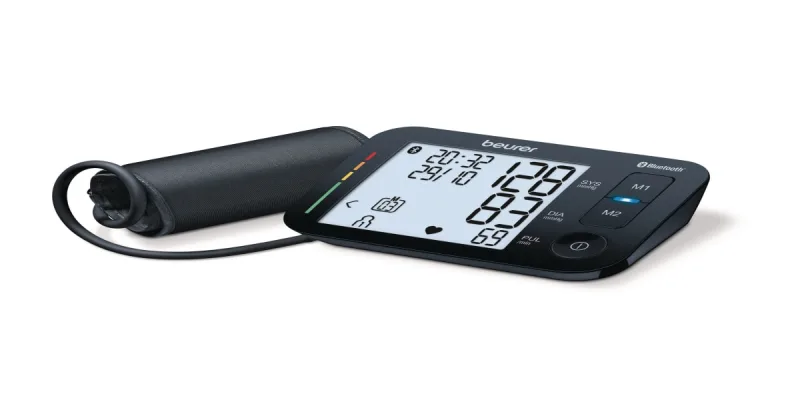 Beurer BM 54
7.6 out of 10
Check Price
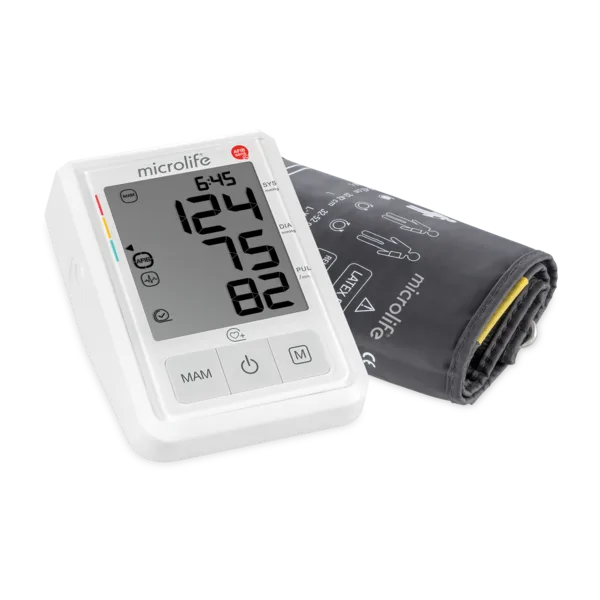 Microlife BP B3 AFIB
7.5 out of 10
Check Price
The Braun ExactFit 3 BUA6150 (9.0) beats the A&D Blood Pressure Monitor UA-651 (8.7) because it leaves owners a little happier and is the newer design.
A mid-priced monitor that ships with two cuff sizes, so a wide range of arms is covered without buying extras. It averages your last three readings.
Each bar shows its place in this guide, so a full bar is 1st of 10. How happy owners are counts for most of the score.
A long-running budget monitor that keeps things simple: a 30-reading memory, an average and a slim cuff.
Each bar shows its place in this guide, so a full bar is 1st of 10. How happy owners are counts for most of the score.
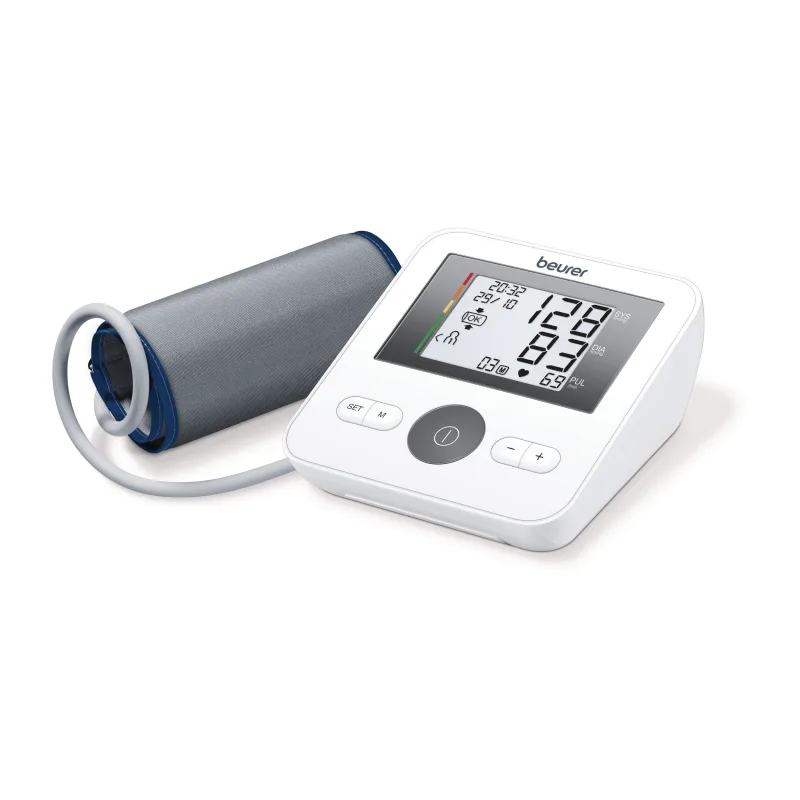
A budget monitor with four user profiles of 30 readings each and a wide cuff range. It has no Bluetooth, so readings stay on the device.
Each bar shows its place in this guide, so a full bar is 1st of 10. How happy owners are counts for most of the score.
A one-piece upper-arm monitor with no tube or separate unit, so the whole thing wraps round the arm. It syncs to the Omron Connect app over Bluetooth.
Each bar shows its place in this guide, so a full bar is 1st of 10. How happy owners are counts for most of the score.
A slim, rechargeable monitor that syncs readings to the Withings app over Wi-Fi or Bluetooth. Built for people who want a tidy app history to show a GP.
Each bar shows its place in this guide, so a full bar is 1st of 10. How happy owners are counts for most of the score.
A simple Braun with one universal cuff and colour-coded results. It sits close to the ExactFit 3 on price but comes with one cuff size, not two.
Each bar shows its place in this guide, so a full bar is 1st of 10. How happy owners are counts for most of the score.
An Omron upper-arm model that screens for possible atrial fibrillation on each check and syncs readings to the Omron Connect app.
Each bar shows its place in this guide, so a full bar is 1st of 10. How happy owners are counts for most of the score.
The no-frills Omron: one button, a clear display and a cuff for average arms. It keeps a 30-reading memory and flags irregular heartbeats.
Each bar shows its place in this guide, so a full bar is 1st of 10. How happy owners are counts for most of the score.
A Bluetooth monitor with a large cuff range and 7-day averages. Suits a larger arm and an app log, if the pairing behaves.
Each bar shows its place in this guide, so a full bar is 1st of 10. How happy owners are counts for most of the score.
A plain upper-arm monitor that checks for atrial fibrillation during a normal reading. It has no app, so it suits someone who wants the screening without a phone.
Each bar shows its place in this guide, so a full bar is 1st of 10. How happy owners are counts for most of the score.
An upper-arm monitor that is clinically validated, with a cuff that fits your arm. For most people that means a model such as the Omron EVOLV or X7 Smart AFib if you want an app, or the Braun ExactFit 3 or A&D UA-651 if you want something plain and affordable. We compared 19 models and ranked these ten from published reviews and owner ratings.
Upper arm. Wrist monitors are very sensitive to arm and wrist position, so readings can shift if your wrist is not at heart height. Wearable and watch-style devices have the same weakness, so none of the ten here is a wrist or watch model. Use one to spot trends, and use a cuff for readings you share with a doctor.
Look it up on the British and Irish Hypertension Society (BIHS) list of validated monitors at bihs.org.uk, which matters more than the brand name. Listings usually describe a model as validated, but the BIHS list is the check. Look up the exact model code, because Omron and others replace models often and a similar-sounding name may not be listed.
Measure round the middle of your bare upper arm with a soft tape. Most standard cuffs cover about 22 to 32cm, and larger cuffs run to 42 or 45cm. A cuff that is too small reads high and one that is too big reads low. The Braun ExactFit 3 comes with two sizes, and the Beurer BM 54 covers up to 44cm.
Price does not decide accuracy, validation does. The A&D UA-651 and Beurer BM 27 are among the cheapest here, and plenty of validated models cost little. What extra money buys is Bluetooth, an app, more user profiles and AFib screening. Compare any new monitor against a reading taken at your GP surgery or pharmacy.
No. A plain model with a memory and an average works well if you write readings in a diary. An app helps if you take many readings, share them with a GP, or have two people using one monitor. For the best readings, rest for five minutes, sit with your back supported and your arm at heart level, take two readings a minute apart, and use the same time each day. Home readings do not replace medical advice, and an irregular heartbeat or AFib flag is a reason to see a clinician, not a diagnosis.
Every score here comes from our ranking model; no editor sets the order. We haven't read the review sites for this guide yet, so for now it is led by owners. It ranks products by how happy owners are, holding back any product few owners have rated until more agree. How many rated it and how new it is only settle close calls, and value for money earns its own badge rather than a higher place. We compared 19 models for this guide before settling on these ten.
Brands can't pay to be included or to move up. We last checked these picks in November 2026.
How we rank, in fullA mid-priced monitor that ships with two cuff sizes, so a wide range of arms is covered without buying extras. 9.0 out of 10.